
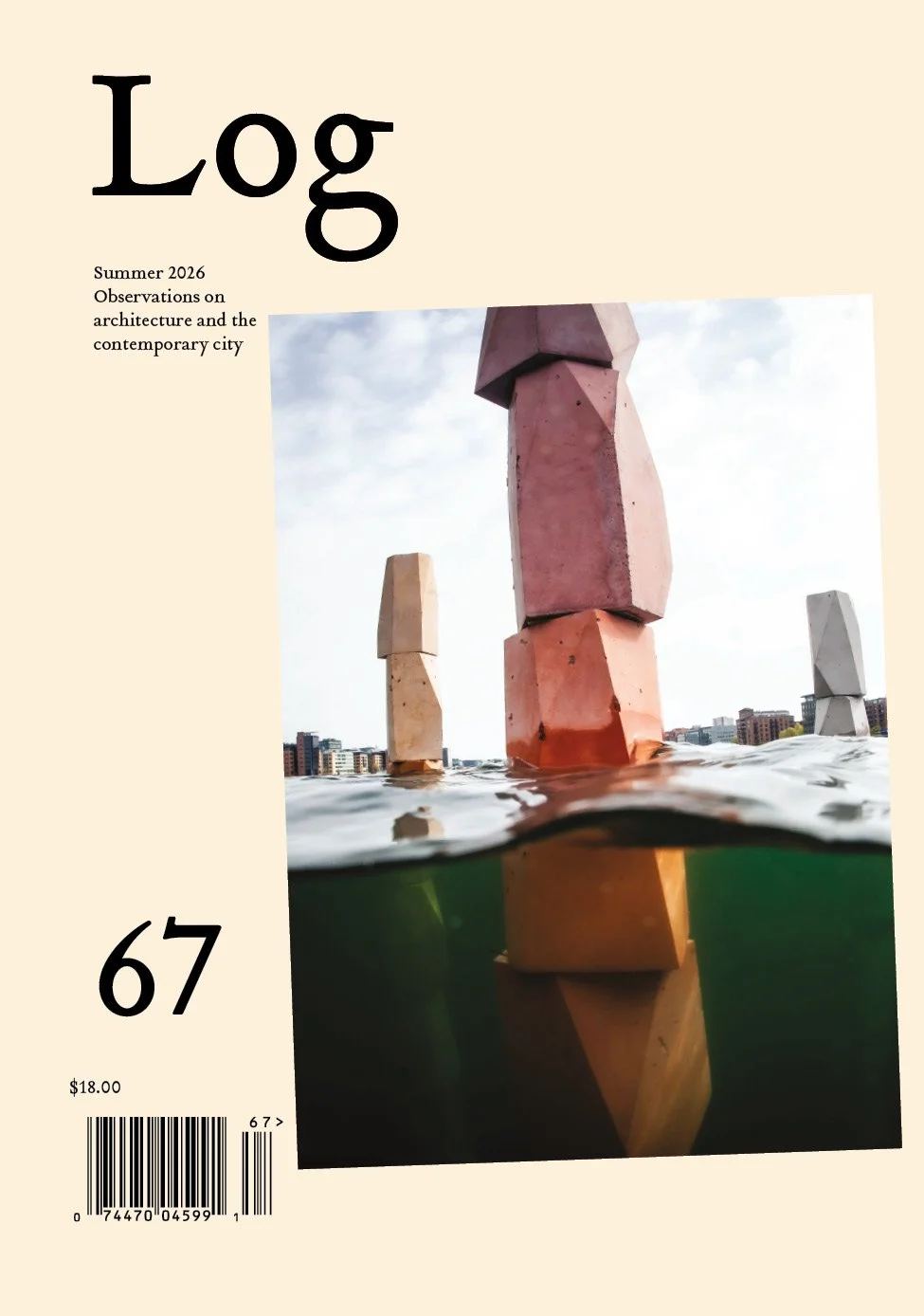
Log 67
Summer 2026
This summer’s open issue gathers new and returning voices on concerns ranging from the impacts of Big Tech to analyses of big buildings.
Angus Taylor Wong and Centre for Research both join the growing discussion of data-driven technology and its questionable effects on the built environment. Alongside these innovations that reshape the systems we thought we knew, Devin Jernigan traces the commercialization of the experimental architecture of the ’90s, and Antonio Petrov considers the aftermath – the current case of understated design that goes largely unnoticed.
Looking further into contemporary practice, Michelle JaJa Chang addresses opacity in the works of Smiljan Radić and Junya Ishigami, arguing that seeing architecture is not the same as understanding the processes of design and construction. Jimenez Lai echoes this idea when he distinguishes between Los Angeles architects who reveal or conceal tectonics. Edgar Rodriguez surveys design approaches that (re)organize material and waste to produce new content. Maryam Eskandari makes the case for relational preservation over physical restoration when examining the destruction of sites in Iran. Underscoring the power architecture holds over the lives around it, Shane Ah-Siong and Winfred Ovur turn to design’s role in the displacement and ruin of communities.
Thomas Weaver tells the story of artist Madelon Vriesendorp and her apartment stuffed with objects, Michael Cadwell recounts the strangeness of houses by Turner Brooks, and Catherine Ingraham views the convincing cave art facsimiles at Lascaux. Looking at traditional small-building techniques, Erin Besler and Narciso Novogratz contemplate how such methods have become symbolic of real or imagined pasts.
Examining the big picture, Stanislaus von Moos takes us through the new LACMA galleries and all their baggage, while Pier Paolo Tamburelli and Adam Sherman uncover the hidden monumentality, both ancient and modern, of Milan’s San Siro stadium. Thomas Kelley reads the Obama Presidential Center against the long history of the obelisk, and Preston Scott Cohen turns to other lithic buildings, tracking a contemporary architectural language to its origins.


Additional Info
Contents
Shane Ah-Siong, “Displacement by Design”
Erin Besler, “Still Standing but Not Standing Still”
Michael Cadwell, “The Uncanny Houses of Turner Brooks”
Centre for Research, “The Architecture of Asymmetrical Withdrawal”
Michelle JaJa Chang, “Opacity”
Preston Scott Cohen, “The Lithic Idiom”
Maryam Eskandari, “Intact but Unreadable”
Catherine Ingraham, “About Lascaux”
Devin Jernigan, “The ‘90s: Hacked in Reverse”
Thomas Kelley, “I am not an obelisk.”
Jimenez Lai, “Reveal or Conceal: A Tale of Two LAs”
Narciso Novogratz, “Sam’s Town”
Winfred Ovur, “Corinthian Perpetuity”
Antonio Petrov, “Designed Disappearance”
Edgar Rodriguez, “Organized-content”
Adam Sherman & Pier Paolo Tamburelli, “San Siro Stadium as a Monument”
Angus Taylor Wong, “From the Valley to the Island”
Stanislaus von Moos, “LACMA’s Coming of Age, or, Implosion as Extroversion”
Thomas Weaver, “Homeward Bound”
And observations by Tom Collins, Cynthia Davidson, Riccardo Monella, and Julia Tyson